How to ensure your nonprofit board keeps everyone accountable to the mission

By Tamara Leonard & Jennifer Brogee
Originally published in the Fall 2025 Edition of the Research Roundtables at Regent University. Read the original paper here
This article presents 15 strategies that can be implemented within nonprofit organizations and boards to enable courageous accountability toward the mission. These recommendations were developed through a systematic review of scholarly research on nonprofit leadership and followership, application of the core concepts of Chaleff’s (2009) courageous followership model, and inclusion of the authors’ practical experience as nonprofit founders. By integrating theoretical frameworks with real-world insights, four central themes emerged that inform meaningful board engagement and organizational sustainability: board member selection, board training, board structure, and director and board chair behaviors. Each recommendation is grounded in both empirical research and practitioner experience, collectively offering a clear pathway for nonprofit organizations to address challenges in sustainable leadership models and ensure long-term mission impact.
Inspiring Courageous Accountability
Chaleff (2009) developed a model of courageous followership that defines the intentional, initiative-driven partnership between leaders and followers, in which followers share responsibility for organizational success. Courageous followers remain accountable for their actions while willingly granting leaders authority, yet they never surrender their autonomy or values. Chaleff’s framework identified five dimensions of courageous followership: the courage to assume responsibility, the courage to serve, the courage to challenge, the courage to participate in transformation, and the courage to take moral action. The following sections examine research-based strategies that foster these behaviors within nonprofit boards. Figure 1 summarizes the research-based strategies.
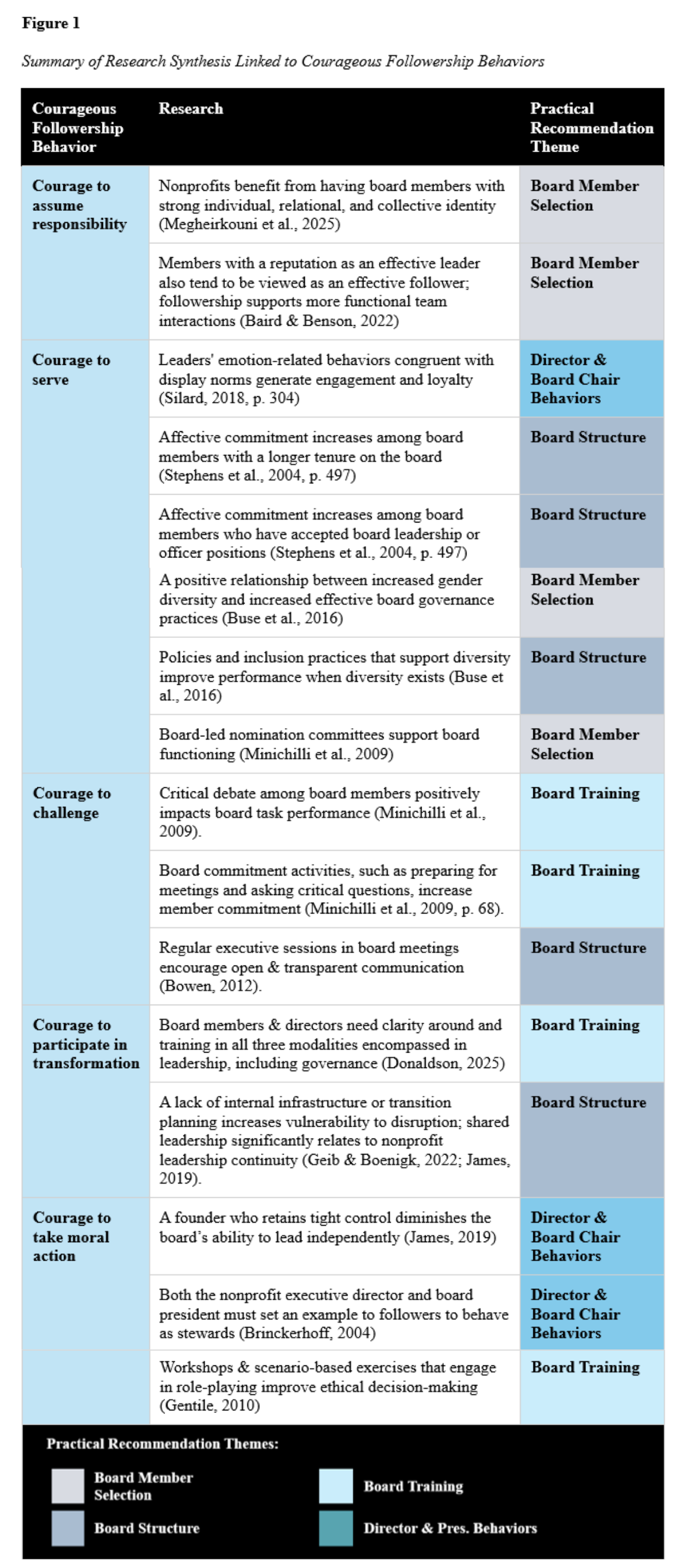
Strategies for Board Member Selection
The research synthesis identified strategies for board member selection. Selecting nonprofit board members is a critical process that shapes organizational effectiveness, diversity, and long-term success. An intentional, evidence-based recruitment strategy ensures the board includes individuals whose skills, identities, and values align with the organization's mission and leadership needs.
· Nonprofit boards should recruit members with strong follower identities and proven followership effectiveness (Baird & Benson, 2022; Megheirkouni et al., 2025).
· Boards benefit from members known as both effective leaders and effective followers (Baird & Benson, 2022) and from increased gender diversity (Buse et al., 2016).
· Nomination committees should objectively select and retain members based on organizational needs and qualifications rather than personal relationships or founder influence, ensuring diverse expertise and effective governance (James, 2019; Minichilli et al., 2009).
Strategies for Board Training
Comprehensive training programs equip board members with the knowledge, skills, and confidence needed to fulfill their governance, legal, and ethical responsibilities effectively. Such programs strengthen decision-making, risk management, and strategic planning capabilities, enabling boards to operate with greater accountability and long-term impact.
· Boards benefit from training in followership, leadership, and governance practices (Donaldson, 2025).
· They should cultivate a board culture that emphasizes preparation and encourages critical questioning (Minichilli et al., 2009).
· Boards should encourage constructive debate among members (Minichilli et al., 2009).
· Facilitating workshops and discussions around scenario-based ethical case studies further enhances members’ moral reasoning and ethical decision making (Gentile, 2010).
Strategies for Board Structure
Board structure defines how authority, accountability, and collaboration are organized within a nonprofit’s governance framework. A well-designed structure strengthens organizational capacity by ensuring role clarity, promoting effective communication, and aligning leadership functions with the nonprofit’s mission and strategic priorities (Bowen, 2012; Donaldson, 2025).
· Boards should invest in board member retention strategies to increase board member tenure (Stephens et al., 2004).
· By providing leadership opportunities for board members, such as office and committee leadership positions, boards encourage courageous followership (Stephens et al., 2004).
· Boards should establish internal infrastructure or use transition planning to define the process of replacing the board director (James, 2019).
· Regular board executive sessions also prompt critical and transparent communication within the board (Bowen, 2012).
· Boards should implement policies that promote diversity across ethnicity, gender, and background to strengthen governance effectiveness (Buse et al., 2016). Without such policies, boards risk underutilizing the potential of diverse perspectives.
Strategies for Director and Board Chair Behaviors
The director and board president should exemplify stewardship, accountability, and community-first leadership, serving as role models who prioritize organizational integrity and collective success (Brinckerhoff, 2004).
· They foster courageous followership by demonstrating emotional intelligence and authenticity that align with organizational display norms (Silard, 2018).
· The director and board president set the standard for stewardship through transparent decision-making and ethical leadership (Brinckerhoff, 2004).
· Founders must release excessive control and empower the board to fulfill oversight and strategic planning responsibilities, ensuring balanced governance and sustainable leadership continuity (James, 2019).
Conclusion
When nonprofits falter due to founder transitions, board disengagement, or organizational drift, the underlying issue often stems from an overreliance on the founder or leader rather than on engaged followership (Froelich et al., 2011; James, 2019). Communities depend on nonprofits to address essential needs that neither government nor markets adequately meet (Smith Arrillaga et al., 2025). Implementing courageous followership principles equips nonprofit leaders, board members, and staff to sustain mission integrity, enhance accountability, and promote collaboration across all levels of stewardship. Ultimately, effective nonprofit governance demands a proactive commitment to shared leadership and mutual accountability.
The 15 strategies developed through scholarly research and practitioner experience provide a practical framework for cultivating the courage to assume responsibility, serve, challenge, transform, and act morally, ensuring that nonprofits continue to thrive beyond their founders and advance their missions for generations. It is equally important that courageous followership extends beyond boards and staff to include volunteers, beneficiaries, and other key stakeholders, thereby strengthening organizational capacity and engaging the broader community in shared stewardship. All types of nonprofits benefit from embracing these recommendations, not just those facing founder’s syndrome. Ultimately, courageous followership establishes a foundation for enduring impact. A nonprofit’s future rests on the courage of those who step up to lead and follow with integrity, ensuring the mission endures.
References
Baird, N., & Benson, A. J. (2022). Getting ahead while getting along: Followership as a key ingredient for shared leadership and reducing team conflict. Frontiers in Psychology, 13. https://doi.org/10.3389/fpsyg.2022.923150
Blevins, D. P., Ragozzino, R., & Eckardt, R. (2020). Corporate governance and performance in nonprofit organizations. Strategic Organization, 20(2), 293–317. https://doi.org/10.1177/1476127020921253
Boustani, L., & Boustani, R. (2017). Innovation in organizations having founder’s syndrome. Problems and Perspectives in Management, 15(2), 517–524. https://doaj.org/article/cdd478d5a87345feaacf7d5b0b17ca04
Bowen, W. G. (2012). The board book: An insider's guide for directors and trustees. W.W. Norton & Company.
Brinckerhoff, P. C. (2004). Nonprofit stewardship. Amherst H. Wilder Foundation.
Buse, K., Bernstein, R., & Bilimoria, D. (2016). The influence of board gender diversity on nonprofit governance effectiveness. Journal of Business Ethics, 133(1), 179–191. https://doi.org/10.1007/s10551-014-2352-z
Chait, R. P., Ryan, W. P., & Taylor, B. E. (2005). Governance as leadership: Reframing the work of nonprofit boards. Wiley.
Chaleff, I. (2009). The courageous follower: Standing up to and for our leaders (3rd ed.). Berrett-Koehler.
Chaleff, I. (2015). Intelligent disobedience: Doing right when what you’re told to do is wrong. Berrett-Koehler.
Donaldson, W. M. (2025). Leaders as followers: Don’t forget governance. Journal of Management Development, 2025. https://doi.org/10.1108/jmd-10-2024-0360
Eva, N., Wolfram Cox, J., Tse, H. H. M., & Lowe, K. B. (2021). From competency to conversation: A multi-perspective approach to collective leadership development. The Leadership Quarterly, 32(5). https://doi.org/10.1016/j.leaqua.2019.101346
Froelich, K., McKee, G., & Rathge, R. (2011). Succession planning in nonprofit organizations. Nonprofit Management and Leadership, 22(1), 3–20. https://doi.org/10.1002/nml.20037
Geib, M., & Boenigk, S. (2022). Improving nonprofit succession management for leadership continuity: A shared leadership approach. Nonprofit Management & Leadership, 33(1), 59–88. https://doi.org/10.1002/nml.21508
Gentile, M. C. (2010). Giving voice to values: How to speak your mind when you know what’s right. Yale University Press.
Internal Revenue Service. (2025). Exempt organizations business master file extract. U.S. Department of the Treasury. https://www.irs.gov/charities-non-profits/exempt-organizations-business-master-file-extract-eo-bmf
James, R. (2019). Leadership transition: Overcoming the threat of founder's syndrome. Praxis series paper no. 9. INTRAC. https://www.intrac.org/resources/praxis-series-paper-no-9-leadership-transition-overcoming-the-threat-of-founders-syndrome/
Jiang, X., Snyder, K., Li, J., & Manz, C. C. (2021). How followers create leaders: The impact of effective followership on leader emergence in self-managing teams. Group Dynamics: Theory, Research, and Practice, 25(4), 303–318. https://doi.org/10.1037/gdn0000159
Kellerman, B. (2008). Followership: How followers are creating change and changing leaders. Harvard Business Press.
Linville, M., & Rennaker, M. (2022). Essentials of followership: Rethinking the leadership paradigm with purpose (2nd ed.). Kendall Hunt Publishing
Megheirkouni, M., Abdullah, A., & Avdukic, A. (2025). Followership identity construction: An insight on the non-profit sector. Leadership and Organization Development Journal, 46(3), 501–523. https://doi.org/10.1108/LODJ-09-2024-0563
Minichilli, A., Zattoni, A., & Zona, F. (2009). Making boards effective: An empirical examination of board task performance. British Journal of Management, 20(1), 55–74. https://doi.org/10.1111/j.1467-8551.2008.00591.x
One Love Global Wellness Foundation. (2025). Annual impact report. https://oneloveglobalwellness.weebly.com/
Riggio, R. E. (2020). Followership research: The other side of leadership. Routledge.
Silard, A. (2018). The connection: How leaders can engage followers through authentic emotion. Jossey-Bass.
Smith Arrillaga, E., Yang, E., & Im, C. (2025). State of nonprofits report 2025. The Center for Effective Philanthropy. https://cep.org/wp-content/uploads/2025/05/NVP_State-of-Nonprofits_2025.pdf
Stephens, R. D., Dawley, D. D., & Stephens, D. B. (2004). Commitment on the board: A model of volunteer directors' levels of organizational commitment and self-reported performance. Journal of Managerial Issues, 16(4), 483–504. https://www.jstor.org/stable/40604465
Toepler, S. (2003). Grassroots associations versus larger nonprofits: New evidence from a community case study in arts and culture. Nonprofit and Voluntary Sector Quarterly, 32(2), 236–251. https://doi.org/10.1177/0899764003032002004
Uhl-Bien, M., Riggio, R. E., Lowe, K. B., & Carsten, M. K. (2014). Followership theory: A review and research agenda. The Leadership Quarterly, 25(1), 83–104. https://doi.org/10.1016/j.leaqua.2013.11.007
